ICCP International Committee of Chemical Programming
1. Scientific View of History
Over the past century, the research on microscopic matter has developed steadily alongside quantum chemistry.
From the perspective of diversified scientific development, a parallel and independent research route built on classical mechanics of microscopic particles was sidelined a century ago.
Looking at various engineering disciplines: electrical engineering has its dedicated descriptive languages; civil and mechanical engineering adopt standardized notation systems. Computer-aided design also supports modeling and design through programming languages.
For microscopic substances and chemical systems, numerous molecular structures, chemical reactions and material evolution processes are waiting to be standardized and programmed. A dedicated programmable description system that fits its inherent rules has long been absent.
The Programmable Chemistry Framework and its supporting language — the Standard Interactive Chemical Language (SICL) — make up for this long-existing deficiency in the engineering development of microscopic science.
Programmable Chemistry will not deny, reject or oppose any existing achievements in chemistry and physics. It rediscovers and reconstructs this neglected research route, and improves it with modern computing power. Science thrives on diverse directions, multiple perspectives and parallel development. Different research paths explain the laws of matter from different dimensions, learn from each other, and constantly broaden the boundary of human scientific cognition.
 Definition of Programmable Chemistry: A cross-disciplinary research system built on microscopic particle dynamics within the framework of classical mechanics, designed for comprehensive computer-based description of chemical reactions. It redefines molecular ontology and relevant rules from a computer perspective, standardizes the modeling of molecular structures, particle interactions and chemical reactions. With the dedicated chemical language SICL, it realizes standardized description and logical deduction of chemical reactions, and enables the programmable generation and decomposition of molecules.
2. Core Arguments
Innovation and progress in natural science always rely on the advancement of overall technologies.
In the era with limited computing power, humans could not carry out high-precision, full-process and repeatable numerical calculation on the movement of microscopic particles. Restricted by observation tools and computing capability, researchers had to depend on statistical induction, probability fitting and macroscopic phenomena to deduce microscopic mechanisms. This research approach has been used for a hundred years.
This is a historical path shaped by the limitations of its times, rather than the only objective way to interpret the essence of matter.
With the maturity of high-performance computing, program-based modeling and digital simulation today, we have acquired the conditions to explore new research directions.
We are no longer limited to explaining phenomena via probability statistics. Sufficient computing power allows us to simulate the whole process of deterministic particle motion, structural bonding and regular evolution of microscopic matter.
The breakthrough of computing tools has given rise to a brand new scientific research path:
Based on classical particle mechanics, we can realize definable, decomposable, calculable, programmable and reusable accurate description of microscopic matter.
This is where the Programmable Chemistry Framework originates.
Different technical fields have evolved independently and focused on their own application scenarios. Current industrial resources are mainly allocated to practical engineering projects that can deliver quick results. Meanwhile, existing research focuses on targeted technical development within separate routes. Few mainstream research modes integrate computational modeling, particle dynamics and molecular engineering as a complete system.
Given the above background, there is huge room to explore and build a complete practical system for deterministic and programmable calculation of microscopic matter.
Traditional probability-based microscopic research solves cognitive problems in the age lacking precise calculation.
Programmable Chemistry focuses on programming description, standardized modeling and molecular calculation in the era of powerful computing.
The two are complementary systems for different times, tools and application scenarios. Together, they improve human cognition and engineering practice of microscopic matter.
Rooted in two original fundamental theories — New Theory of Material Evolution and First-Class Particle Dynamics, this framework covers particle motion logic, molecular structure rules, standardized programming and molecular calculation. It provides a brand-new research system for chemical simulation, molecular design, new material development and pharmaceutical modeling.
Adhering to the principle of seeking truth from science, all theoretical models, rules and reasoning of Programmable Chemistry will be continuously tested and verified in long-term application. The improvement of a scientific system is an ongoing process. We will never solidify our cognition or close our research paths. We always follow objective scientific facts and keep iterating, revising and optimizing continuously.
3. Core Philosophy
Programmable Chemistry adheres to the idea of openness and global sharing.
We publish the top-level structure, research logic and theoretical framework of Programmable Chemistry in phases, bringing new ideas to new materials, chemical engineering, pharmaceutical research and energy industries.
We also release the basic definitions and top-level specifications of the Standard Interactive Chemical Language (SICL) in phases. Researchers, developers and enthusiasts worldwide may study and expand on them in phases; detailed grammar rules and implementation specifications are open via targeted access.
We develop alongside mainstream scientific directions, and jointly enrich the global research system of microscopic matter.
The Programmable Chemistry Framework is officially defined as an open research system. All theoretical achievements, research results and industrial works developed by any individual or organization based on this framework and SICL shall be owned independently by the creators.
4. Core Mission
Founded by an independent researcher, Programmable Chemistry is an emerging interdisciplinary research field. Its core mission is to restore the missing branch of science over the past century, and explore new directions of chemistry based on classical mechanics.
This platform serves to publish research viewpoints, theories and industrial standards, and act as an open communication space for global joint improvement. Researchers from all walks are welcome to join discussions and polish the system together.
We hereby announce to the whole world the official launch of the Programmable Chemistry Framework. The research route based on classical mechanics of microscopic particles will never be neglected again. We will keep improving, sticking to and promoting this field, and prevent it from being buried once more.
For research communication and idea discussion , please contact the founder : Jiale Wen, Email: 79212131@qq.com| admin@iccp.cloud
5. SICL Language
SICL (Standard Interactive Chemical Language)
Created in May 2026, SICL is the world’s first general-purpose descriptive language for programmable chemistry, computational simulation and digital modeling.
SICL enables standardized basic description and structured data storage for microscopic structures and chemical reaction systems. It is designed to adapt to digital chemical simulation, dynamic reaction calculation, intelligent modeling and cross-platform data collaboration. It connects traditional chemistry and computer science at the fundamental level.
SICL.CLOUD releases the grammar definitions and official standards of SICL in phases. We aim to provide a unified, universal and collaborative underlying language standard for global programmable chemistry, and drive scientific and technological innovation for humanity.
6. Preservation Statement
This website is the only original source of Programmable Chemistry across the globe. All published research content, standards and theoretical definitions are recorded with tamper-proof blockchain timestamps, which permanently confirm the origin information of this framework.
7. Origin of Programmable Chemistry
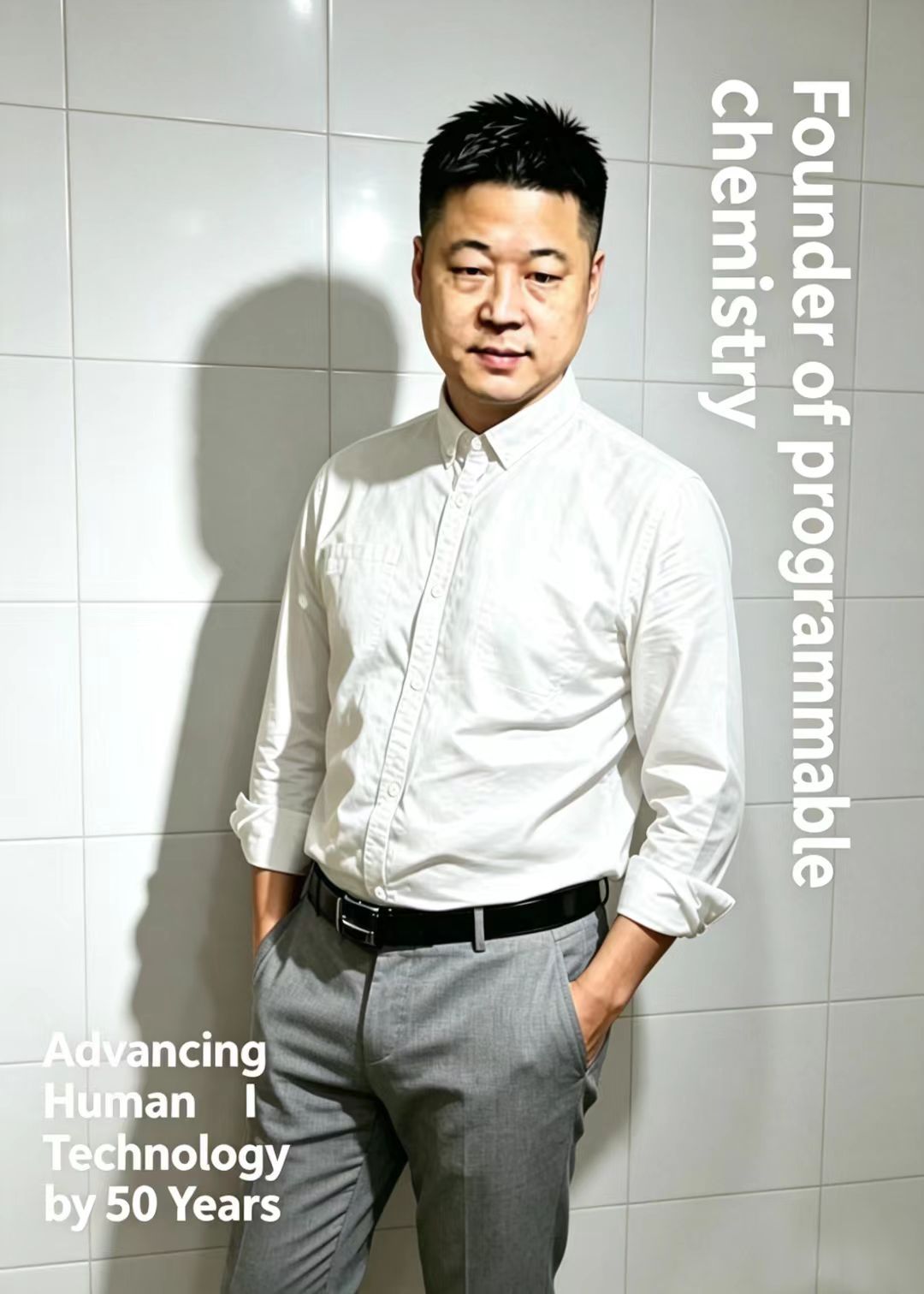
The programmable chemistry system is an original achievement. It comes from years of interdisciplinary study, Eastern philosophical research and Western foundational engineering ideas.
When I studied microelectronics, I found flaws left over in classical physics. Some definitions of microscopic charges and motion models were vaguely written and hard to understand. Therefore, I always viewed existing theories of microscopic matter carefully, and kept exploring the fundamental laws of material movement.
I studied Linux system principles, C/C++, Java kernel and compiler technology for a long time, and formed standardized, generalizable and programmable engineering thinking. Meanwhile, I systematically learned chemistry and pharmacy, including inorganic structures, organic molecular bonding and evolution.
During my study, I noticed widespread problems in modern chemistry, molecular design and pharmaceutical development: lack of basic tools, scattered theories, and insufficient digital computing methods. Traditional modes cannot meet systematic research demands. This pushed me to restructure the basic system and improve industry conditions.
Combining traditional Eastern philosophy and strict Western engineering logic, I formed a new way to analyze microscopic material laws and built a complete new theoretical system.
Based on these theories, I formally established this new field named programmable chemistry in May 2026. I started developing SICL (Standard Interactive Chemical Language), together with its framework, terminology and mathematical models.
Programmable chemistry covers computer science, compilers, programming languages, applied mathematics, modeling, microphysics, inorganic chemistry, organic chemistry, pharmaceuticals and molecular design. This research is full of difficulties.
I am confident that this system can be used in industrial scenarios and produce practical technical value. Currently, the project is steadily undergoing testing and iterative upgrades.
ICCP Open Programmable Chemistry License V1.0
1. Purpose & Positioning
This agreement serves as the official public licensing specification for the Programmable Chemistry research system.
As a brand-new scientific research field, Programmable Chemistry is fully open to the world, free to access, available for independent research and derivative expansion.
This agreement does not monopolize research fields, restrict academic exploration or block scientific communication. It only standardizes online public usage, retains the original source traceability of the system and safeguards the public ownership of original achievements.
2. Scope of Application
This agreement applies to all content published on ICCP.CLOUD, including the scientific view of history of Programmable Chemistry, theoretical system, research framework, core concepts, mission statements, public documents and all supporting original public documents.
3. Basic Public License
Subject to full compliance with all clauses herein, all individuals and institutions worldwide are granted permanent free permission to:
1. Read, browse, save and disseminate all public content of this system freely;
2. Carry out independent research, experimental verification, directional expansion and derivative innovation based on this system.
This system remains permanently open and free of charge with no licensing fees of any kind.
4. Source Traceability Rules (Only Binding Clause)
When any entity carries out secondary dissemination, public release or external publication of derivative content, the official original source (ICCP.CLOUD) and information of the original creator of this system must be clearly indicated.
It is prohibited to conceal, erase or replace the original source attribution information of this system.
5. Disclaimer
1. All content of this system is for public scientific research reference only, without any guarantee of absolute applicability.
2. All research, experiments and applications developed based on this system shall bear risks solely by users. The original creator shall not be held jointly liable for relevant consequences.
6. Original Evidence Preservation Statement
The complete research system of Programmable Chemistry is systematically published to the public for the first time globally. All theoretical texts, specification content and this licensing agreement on the official website are publicly released via web pages, and recorded with irreversible hash timestamps on blockchain to permanently solidify the original source information.
7. Validity of This Agreement
This agreement takes effect immediately upon official public release. No offline filing or registration is required, complying with the validity criteria of online public copyright disclosure. All revisions and updates of this agreement will be continuously displayed on the official platform ICCP.CLOUD, and the latest published version shall prevail.